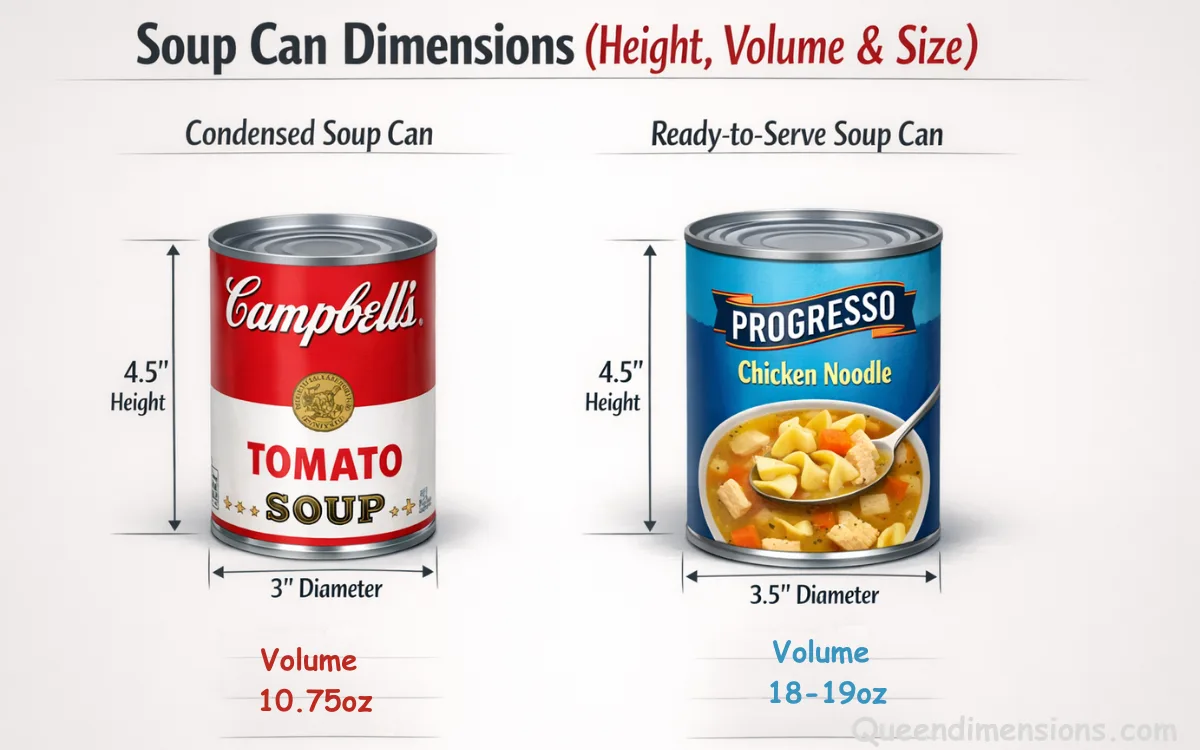
A standard soup can in the USA measures 3 inches in diameter and 4.5 inches in height, holding approximately 10.75 ounces for condensed varieties. Ready-to-serve cans are slightly larger at 3.5 inches wide and 4.5 inches tall, containing 18-19 ounces. These standardized soup can dimensions ensure consistent shelf storage, recipe measurements, and portion control across American kitchens.
Understanding can sizes helps with pantry organization, meal planning, and accurate recipe conversions. Industry codes like #300 and #307 indicate precise measurements in sixteenths of an inch, making it easier to identify capacity and storage requirements.
What Are Soup Can Dimensions?

Soup can dimensions refer to three key measurements: diameter (width across the circular base), height (vertical length from bottom to top), and capacity (volume in fluid ounces).
The most common condensed soup can measures 3 inches in diameter by 4.5 inches tall and holds 10.75 ounces. This format has remained unchanged for decades, allowing manufacturers to optimize production lines and consumers to plan storage space effectively.
Standard Soup Can Sizes in the USA
The United States follows standardized can sizes established by the Can Manufacturers Institute and adopted industry-wide. These formats ensure compatibility with automated filling equipment, sealing machines, and retail shelf systems. Over 2 billion soup cans are sold annually in America, making standardization critical for efficiency.
Common codes include #300, #303, #307, and #10, each representing specific dimensions and capacities.
Condensed Soup Can Dimensions (10.75 oz)

Condensed soup cans measure 3 inches in diameter and 4.5 inches in height, designated as #300 or 300×407 in industry terminology. These cans hold 10.5 to 10.75 fluid ounces of concentrated product requiring water or milk addition before consumption.
This compact format allows efficient shelf storage while maintaining adequate space for labels and branding. The beaded sides provide structural strength during high-heat processing and extend shelf life up to 2-5 years when stored properly.
Ready-to-Serve Soup Can Dimensions (18-19 oz)
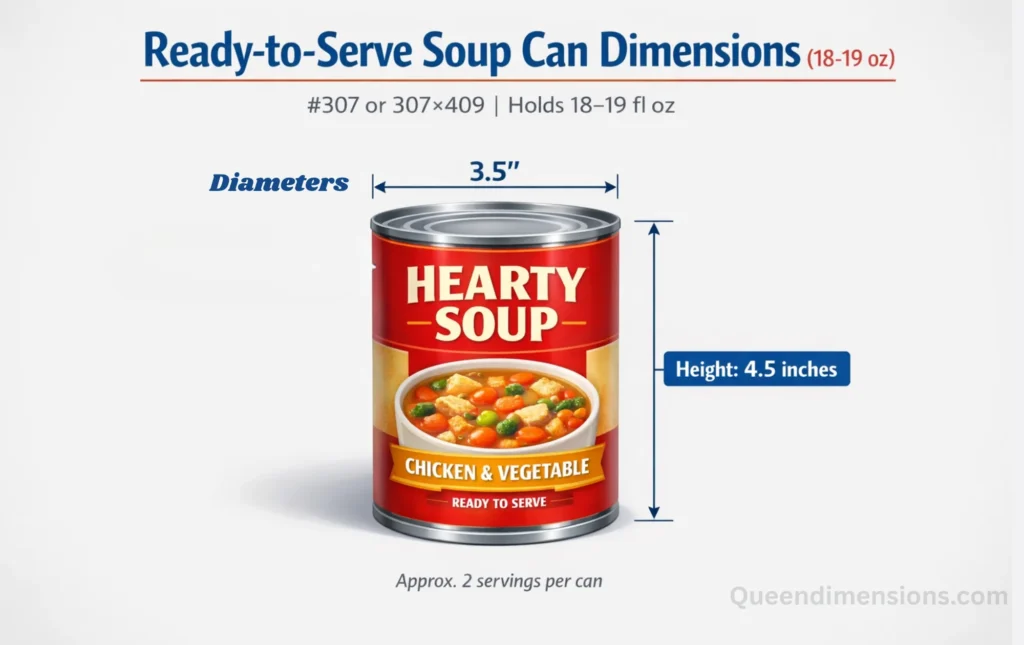
Ready-to-serve soups use slightly larger cans measuring 3.5 inches in diameter by 4.5 inches tall, coded as #307 or 307×409. These containers hold 18 to 19 fluid ounces of fully prepared soup requiring no dilution.
The increased diameter accommodates chunky vegetables, meat pieces, and heartier ingredients. These cans provide approximately 2 to 2.25 servings based on USDA guidelines of 8 fluid ounces per serving.
Small Individual Soup Cans (7.25 oz)
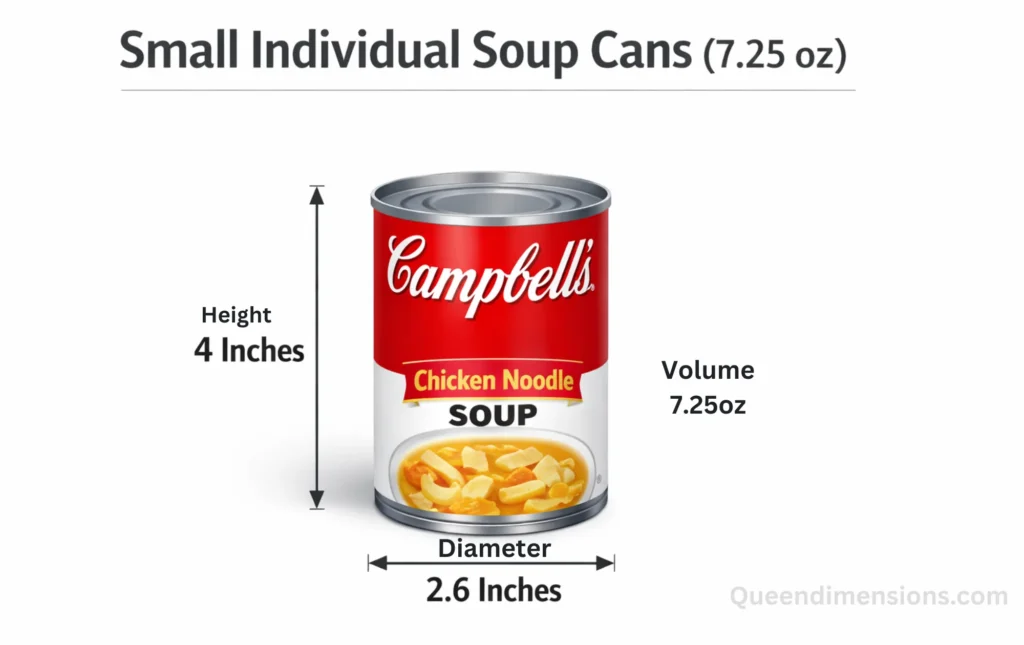
Individual portion cans measure approximately 2.6 inches in diameter and 4 inches tall, holding around 7.25 ounces. These single-serving containers are ideal for lunch boxes, office desks, or portion-controlled meal planning.
The smaller can dimensions fit easily in compact storage spaces and require less refrigerator room after opening. Many brands offer popular flavors in this convenient format for on-the-go consumption.
Large Format Soup Cans (#2.5, #5, and #10)
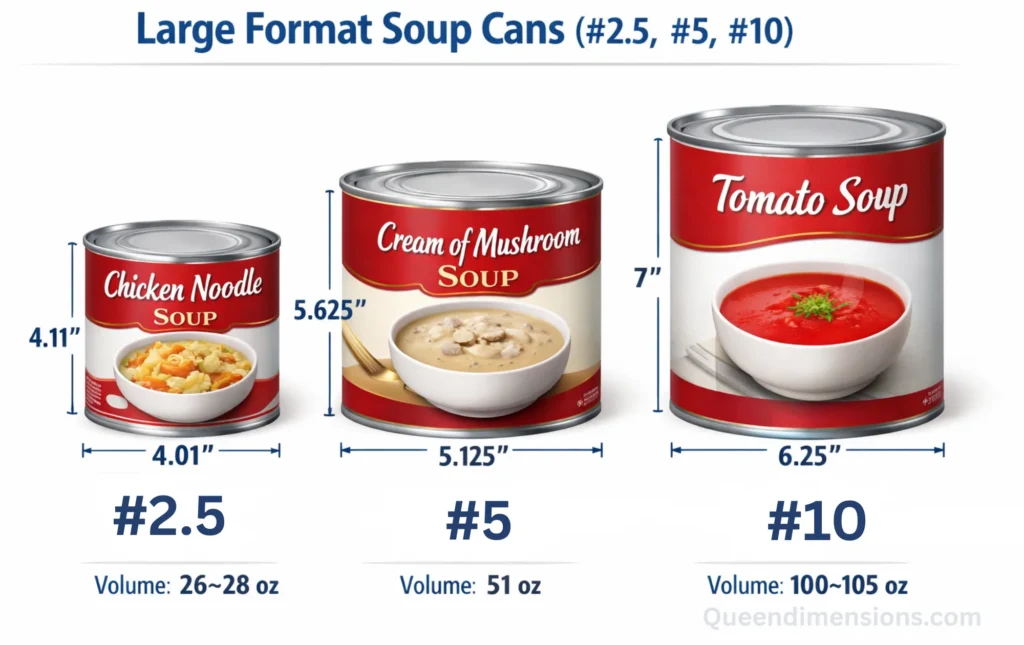
#2.5 cans measure 4.01 inches in diameter by 4.11 inches tall and hold 26-28 ounces, serving family-sized portions.
#5 cans expand to 5.125 inches wide and 5.625 inches high with 51-ounce capacity for bulk meal preparation.
#10 cans are the largest standard size at 6.25 inches in diameter and 7 inches tall, containing 100-105 ounces (approximately 12-13 cups). Food service operations, institutions, and catering businesses primarily use these for high-volume cooking.
RAM Bed Dimensions(Length, Width, Depth & Cargo Specs)
Popular Soup Can Dimensions by Brand

Major soup brands maintain consistent can dimensions to ensure consumer recognition and shelf compatibility.
Campbell’s, Progresso, Pacific Foods, and Amy’s dominate the American soup market, collectively accounting for over 70% of retail sales. Their dimensional standards influence generic and store brands.
Campbell’s Soup Can Dimensions
Campbell’s Condensed soups use the classic 3-inch diameter by 4.5-inch height format, holding exactly 10.75 ounces. This iconic red-and-white can has maintained identical dimensions since the 1960s, creating instant brand recognition.
Campbell’s Chunky varieties measure 3.5 inches wide and 4.5 inches tall with 18.6 to 19-ounce capacity. The Well Yes! line follows similar ready-to-serve specifications for vegetable-rich recipes.
Progresso Soup Can Dimensions
Progresso cans measure 3.375 inches in diameter and approximately 4.4 inches in height, holding 18.5 to 19 fluid ounces. This slightly wider format accommodates larger vegetable chunks and meat pieces characteristic of their premium positioning.
The brand’s light and reduced sodium varieties maintain identical can dimensions despite varying caloric content. Standard #307×409 coding ensures compatibility with existing can opener designs.
Amy’s, Heinz, and Generic Store Brands
Amy’s Organic soups use eco-friendly cans measuring 3 inches in diameter and 4.4 inches tall for 14.5-ounce capacity. Their commitment to BPA-free linings influences production costs but maintains standard external dimensions.
Heinz focuses on international markets but USA versions typically offer 15-ounce cans at 3 inches wide and 4.43 inches high. Generic store brands from retailers like Walmart and Kroger precisely match Campbell’s dimensions for direct shelf comparison.
Understanding Can Size Codes and Industry Standards
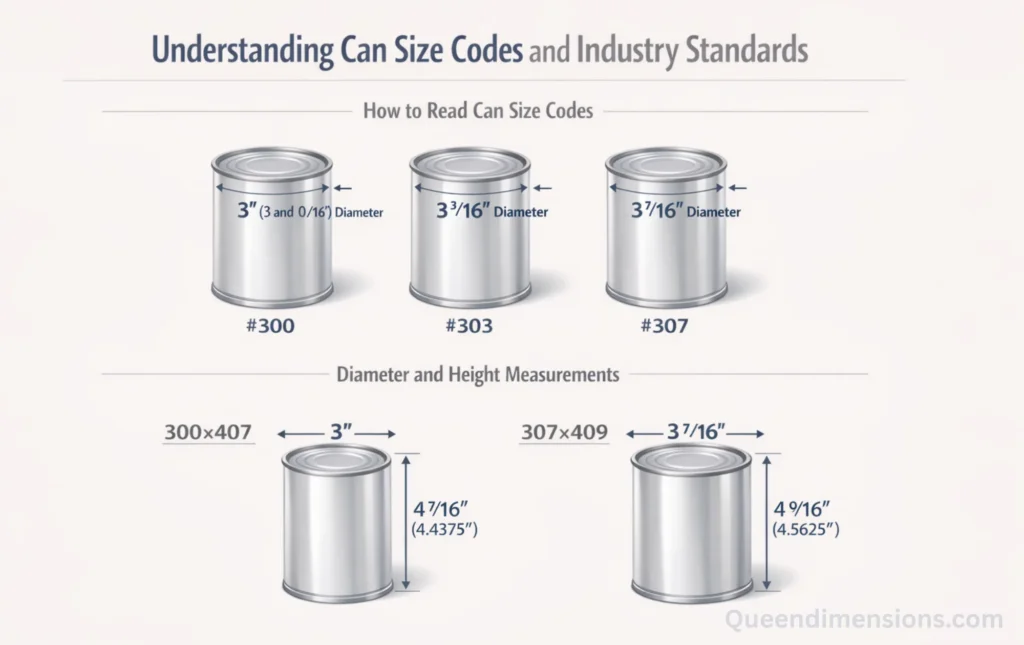
The North American canning industry developed a numerical coding system to standardize can dimensions and streamline manufacturing.
Understanding these codes helps food service buyers order correct quantities and ensures compatibility with sealing equipment. The system has remained consistent since the 1940s, providing historical continuity.
How to Read Can Size Codes (#300, #303, #307)
Can codes use three digits where the first represents whole inches and the final two indicate sixteenths of an inch. #300 translates to 3 and 0/16 inches (exactly 3 inches) in diameter.
#303 means 3 and 3/16 inches (3.1875 inches) wide. #307 indicates 3 and 7/16 inches (3.4375 inches) across. These precise measurements ensure can ends, labels, and filling nozzles align correctly during automated production.
Diameter and Height Measurements in Sixteenths
A complete can size designation includes both diameter and height codes separated by a multiplication sign. 300×407 indicates 3 inches in diameter and 4 and 7/16 inches tall (4.4375 inches).
The 307×409 code means 3.4375 inches wide by 4.5625 inches high. This sixteenth-inch precision matters during high-speed manufacturing where tolerances of even 0.01 inches can cause sealing failures or label misalignment.
Full XL Bed And Mattress Dimensions(Size, Height, Length & Width)
Practical Applications of Soup Can Dimensions

Accurate can dimensions enable efficient pantry design, recipe scaling, and inventory management.
Commercial operations use dimensional data for warehouse layout, transportation logistics, and equipment selection.
Organizing Your Pantry by Can Size
Standard 12-inch deep shelves accommodate soup cans with room for double-stacking. 3-inch diameter cans allow four across in standard cabinetry. 3.5-inch varieties fit three per row, maximizing horizontal space utilization.
Vertical stacking works safely up to three cans high for 4.5-inch tall formats.
Calculating Volume and Capacity from Dimensions
Cylinder volume calculates as π × radius² × height. For a 3-inch diameter can (1.5-inch radius) standing 4.5 inches tall, the formula yields: 3.14 × 1.5² × 4.5 = 31.8 cubic inches.
Converting to fluid ounces requires dividing cubic inches by 1.805, resulting in approximately 10.75 ounces. This mathematical verification confirms label accuracy and helps recipe developers calculate ingredient yields.
Storage and Shipping Considerations
Case packs typically contain 24 cans for #300 sizes and 12 cans for larger formats. Shipping boxes measure based on can diameter and height to minimize wasted space. Properly sized boxes reduce damage during transit.
Recycling programs recycle over 75% of steel cans annually in the USA. Compacting empty cans reduces bin volume by approximately 80%, improving waste management efficiency in both homes and commercial facilities.
Soup Can Capacity and Serving Sizes

FDA regulations require accurate capacity labeling on all food cans. Manufacturers must account for headspace, product density, and fill lines during automated packaging to ensure consistency.
Serving sizes follow USDA dietary guidelines establishing 8 fluid ounces (1 cup) as the standard soup portion. These measurements help consumers track nutritional intake and plan balanced meals.
Understanding Fluid Ounces vs Servings
Fluid ounces measure liquid volume while servings indicate recommended consumption portions. A 10.75-ounce condensed can contains 1.3 servings before water addition. After preparation with one can of water, it yields approximately 2.5 servings.
Ready-to-serve cans holding 18-19 ounces provide 2 to 2.25 servings without dilution. These calculations appear on nutrition labels to guide portion control and caloric intake monitoring.
Is One Can of Soup Equal to One Cup?
No, a standard cup measures exactly 8 fluid ounces while most soup cans exceed this volume. Condensed cans at 10.75 ounces equal approximately 1.3 cups of concentrated product.
Ready-to-serve varieties containing 18-19 ounces provide roughly 2.25 cups of soup. Understanding this distinction prevents recipe errors and ensures accurate nutritional tracking for dietary management.
FAQ’s
What are the dimensions of a soup can?
A standard condensed soup can measures 3 inches in diameter and 4.5 inches in height, holding 10.5-10.75 ounces. Ready-to-serve cans are 3.5 inches wide and 4.5 inches tall with 18-19 ounce capacity.
What size is a 15oz can?
A 15-ounce can typically measures 3 inches in diameter and approximately 4.4 inches in height, commonly used for beans, vegetables, and some soup varieties.
How big is a Campbell’s soup can?
Campbell’s Condensed soup cans are 3 inches in diameter by 4.5 inches tall, containing 10.75 ounces. Chunky varieties measure 3.5 inches wide and 4.5 inches high with 18.6-19 ounce capacity.
What are standard can sizes?
Standard sizes include #300 (15 oz, 3 × 4.4375 inches), #303 (16-17 oz, 3.1875 × 4.375 inches), #2 (20 oz, 3.4375 × 4.5625 inches), and #10 (100 oz, 6.25 × 7 inches).
How big is a can of Progresso soup?
Progresso soup cans measure 3.375 inches in diameter and 4.4 inches tall, holding 18.5 to 19 ounces for ready-to-serve varieties.
Is 1 can of soup 1 cup?
No, condensed cans hold 10.75 ounces (1.3 cups) before preparation. Ready-to-serve cans contain 18-19 ounces (approximately 2.25 cups). One cup equals exactly 8 fluid ounces.
What is a standard serving size of soup?
The USDA defines a standard soup serving as 1 cup or 8 fluid ounces. Condensed soups yield 2.5 servings when prepared, while ready-to-serve varieties provide 2 servings per can.
How many centimeters is a can of soup?
A condensed soup can measures approximately 7.6 cm in diameter and 11.4 cm tall. Ready-to-serve cans are about 8.9 cm wide by 11.4 cm high. Large #10 cans measure 15.9 cm × 17.8 cm.
Conclusion
Understanding soup can dimensions empowers better kitchen organization, accurate recipe conversions, and informed purchasing decisions. Standard formats like 3 inches × 4.5 inches for condensed varieties and 3.5 inches × 4.5 inches for ready-to-serve options provide consistency across American households and commercial operations.
These precise measurements impact everything from pantry storage to nutritional planning. Knowing that a condensed can holds 10.75 ounces while a chunky variety contains 18-19 ounces helps you buy the right amount for your needs and minimize waste.

Hi, I’m Ethan Miller, the admin behind QueenDimensions.com. We make understanding Dimensions simple. Explore clear guides on realms, energy, and hidden layers of reality. No confusion, just clarity.