Building a baseball or softball field requires exact measurements that directly impact player safety and game fairness. Proper field dimensions vary significantly by age group and league level, from youth T-Ball fields with 50-foot bases to professional MLB diamonds with 90-foot base paths.
This comprehensive guide breaks down all standard baseball field dimensions and softball field layouts across every competitive level, ensuring your facility meets regulation requirements while protecting players at every stage of development.
Standard Baseball Field Dimensions by Age Group

Professional & High School Baseball (90-Foot Diamond)
Major League Baseball fields feature 90-foot base paths measured from the back tip of home plate to the back corner of each base. The pitching distance remains exactly 60 feet 6 inches from the pitcher’s rubber to home plate.
The pitcher’s mound stands 10 inches high within an 18-foot diameter circle. High school baseball follows identical infield specifications, creating consistency for developing players. Outfield fences typically extend 325-400 feet from home plate, though professional parks vary widely.
Youth Baseball Progression (Little League to Intermediate)
Little League baseball dimensions scale down to accommodate younger players. The 9-12 age group plays on 60-foot base paths with a 46-foot pitching distance, reducing arm strain while building proper mechanics.
Pony League transitions players gradually upward. Ages 13-14 compete on 80-foot diamonds with 54-foot pitching distances. By ages 15-18, players advance to full regulation 90-foot bases and 60’6″ pitching, preparing them for high school and college competition.
Why the 60 Feet 6 Inches Pitching Distance?
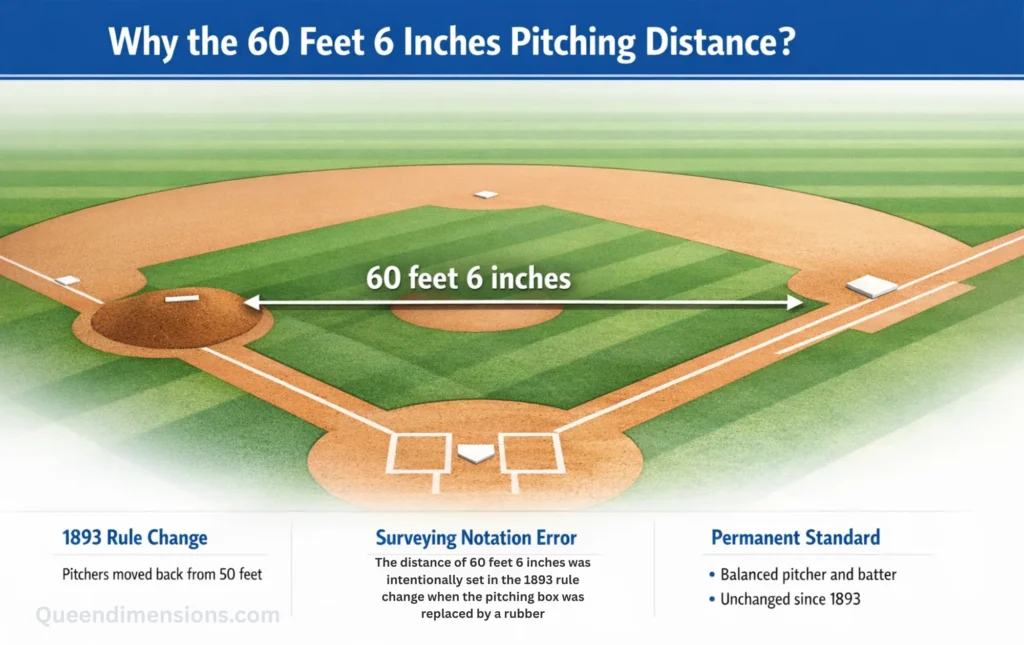
The 60 feet 6 inches measurement originated from an 1893 rule change that moved pitchers back from the original 50-foot distance. Historical accounts suggest a surveying notation reading “60-0” was misinterpreted as “60 feet 6 inches” instead of “60 feet with zero additional inches.”
This accidental measurement became baseball’s permanent standard. The distance proved optimal for balancing pitcher advantage against batter reaction time, and no organization has changed it since 1893.
RAM Bed Dimensions(Length, Width, Depth & Cargo Specs)
Softball Field Dimensions & Layout Specifications
Fastpitch Softball Measurements (College & High School)

Women’s fastpitch softball uses 60-foot base paths at all competitive levels. College and adult leagues maintain a 43-foot pitching distance from the front edge of the pitching rubber to the back tip of home plate.
Youth fastpitch reduces the pitching distance to 35-40 feet for ages 10 and under, gradually increasing to 43 feet by age 14. Outfield fences must be positioned between 190-235 feet from home plate for high school and college fields.
Slowpitch Softball Standards
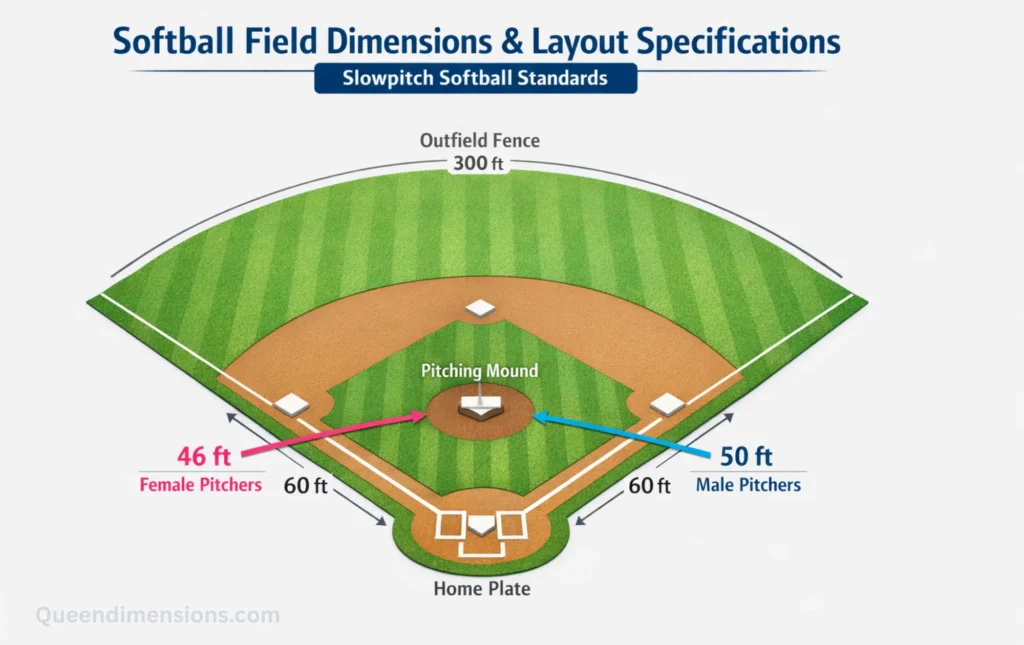
Men’s slowpitch softball maintains the same 60-foot base paths but extends the pitching distance to 50 feet. The extra space accommodates the higher arc required for regulation slowpitch delivery.
Many facilities set pitching at 46 feet for female pitchers and 50 feet for male pitchers on the same field, creating fairness across different throwing styles.
Youth Softball Dimension Breakdown

10U softball (ages 10 and under) uses 60-foot bases with a 35-foot pitching distance. This shorter throw helps young players develop proper windmill mechanics without risking arm injury from overextension.
The 12U and 14U divisions gradually increase pitching from 40 to 43 feet while maintaining standard 60-foot base paths. By age 14, most leagues match adult regulation measurements, preparing players for high school competition.
Baseball vs Softball Key Dimensional Differences
Critical Field Layout Components & Measurement Methods
Home Plate & Batter’s Box Specifications
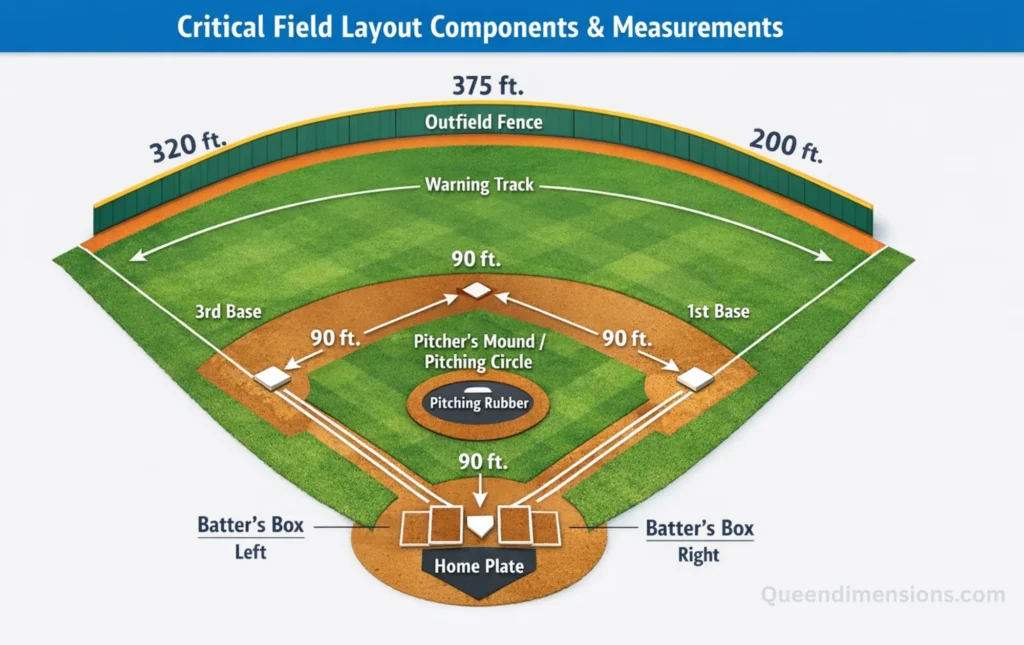
Home plate measures 17 inches across the front edge with 8.5-inch sides forming the distinctive five-sided shape. The pointed rear extends 12 inches, creating the starting point for all field measurements.
Batter’s boxes sit 6 inches from home plate edges, measuring 4 feet wide by 6 feet long. Right-handed and left-handed boxes mirror each other on opposite sides, giving batters proper positioning for their swing mechanics.
Base Positioning & Accurate Measurement Techniques
Measuring base paths begins at the rear point of home plate extending to the back corner of first and third bases. The 90-foot (or 60-foot) measurement forms perfect right angles at each base.
Second base sits at the intersection of lines from first and third bases. The base’s center must align precisely 127 feet 3⅜ inches (baseball) or 84 feet 10¼ inches (softball) from home plate’s rear point for accurate diamond geometry.
Pitcher’s Mound Construction Requirements
Baseball mounds require an 18-foot diameter circle with 10-inch elevation at the pitching rubber. The slope descends gradually, starting 6 inches in front of the rubber to create proper drainage.
Softball pitching circles remain flat at ground level with an 8-foot radius (16-foot diameter). The pitching rubber measures 24 inches long by 6 inches wide in both sports, positioned exactly at regulation distance from home plate.
Outfield Fence & Safety Distances
Minimum fence distances protect player safety while maintaining competitive balance. Youth leagues start at 200 feet, high school requires 300-325 feet, and college recommends 330-400 feet from home plate.
Warning tracks must extend at least 15 feet from outfield fences, providing fielders tactile notice before collision. The different surface texture (typically crushed brick or gravel) alerts players immediately during high-speed pursuits. Backstop placement varies from 25 feet minimum in youth leagues to 60 feet in professional ballparks.
Full XL Bed And Mattress Dimensions(Size, Height, Length & Width)
Complete Dimension Tables for Quick Reference
FAQ’s
Are all bases 90 feet apart?
No, base path distances vary by age group. Youth baseball starts at 50-60 feet, progresses to 70-80 feet for intermediate players, and reaches 90 feet only at high school age and above.
How big is a standard baseball field compared to a softball field?
Baseball fields are substantially larger with 90-foot bases versus softball’s 60 feet, creating an infield 2.25 times larger. Baseball outfield fences extend 325-400+ feet while softball ranges 190-275 feet.
What is the minimum distance to the outfield fence?
Minimum fence distances depend on league level: Little League requires 200 feet, high school mandates 300-325 feet, college recommends 330 feet minimum, and professional leagues suggest 325 feet down lines.
Is 400 feet a long home run?
Yes, 400-foot home runs represent above-average power in any league. MLB data shows only 15-20% of home runs travel 400+ feet, with anything beyond 450 feet entering elite “tape measure” territory.
Why is the pitching distance 60 feet 6 inches?
The 60 feet 6 inches distance resulted from an 1893 surveying error where “60-0” was misread as “60 feet 6 inches” instead of exactly 60 feet, and this measurement became baseball’s permanent standard.
How big is a standard size baseball?
A regulation baseball measures 9 to 9.25 inches in circumference and weighs 5 to 5.25 ounces, featuring a cork and rubber center wrapped in yarn and covered with white leather joined by 108 red stitches.
Conclusion
Proper field dimensions form the foundation of safe, regulation baseball and softball play across all competitive levels.
Understanding these precise specifications helps facilities build compliant fields, ensures fair competition, and protects player safety. Whether constructing new facilities or maintaining existing fields, accurate measurements matter at every level of play—from T-Ball through professional competition.

Hi, I’m Ethan Miller, the admin behind QueenDimensions.com. We make understanding Dimensions simple. Explore clear guides on realms, energy, and hidden layers of reality. No confusion, just clarity.