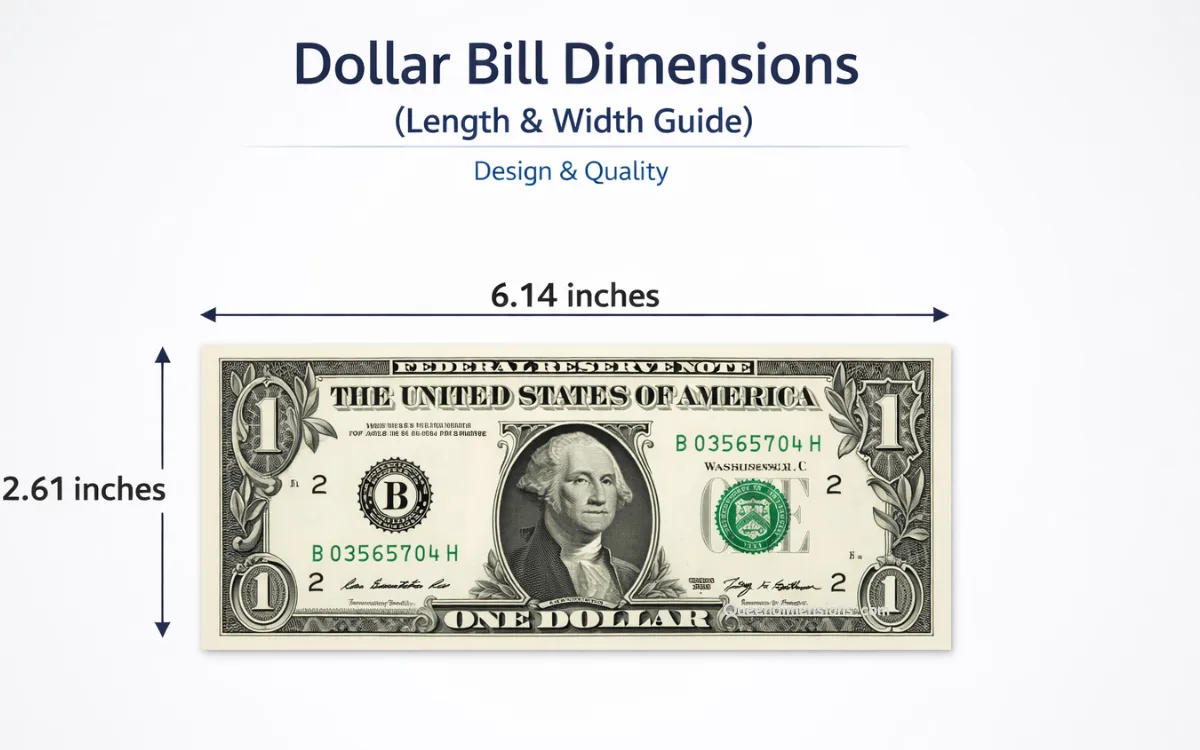
A US dollar bill measures exactly 6.14 inches long by 2.61 inches wide, with a thickness of 0.0043 inches. This standard dollar bill dimension has remained unchanged since 1929 when the Treasury Department modernized American currency.
Every denomination shares these identical measurements. Whether you hold a $1 bill or a $100 bill, the physical size stays constant across all US paper currency currently in circulation.
What Are the Exact Dollar Bill Dimensions?
Standard Size in Inches and Centimeters
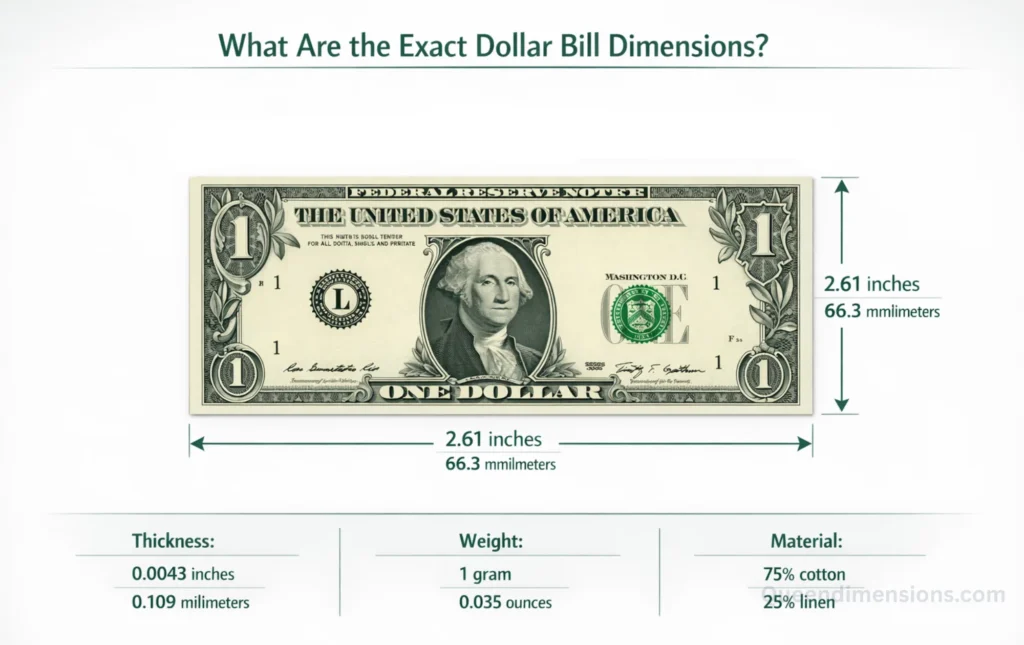
The official dollar bill length is 6.14 inches or 156 millimeters. The width measures 2.61 inches, which equals 66.3 millimeters in the metric system.
The Bureau of Engraving and Printing maintains strict dimensional standards for every bill produced.
Thickness and Weight Specifications
A single dollar bill thickness measures just 0.0043 inches or 0.109 millimeters. Each note weighs approximately one gram or 0.035 ounces.
The bills consist of 75% cotton and 25% linen, not regular paper. This unique blend creates durability that allows a dollar bill to withstand roughly 4,000 folds before tearing.
Dollar Bill Dimensions by Denomination
Are All US Bills the Same Size?
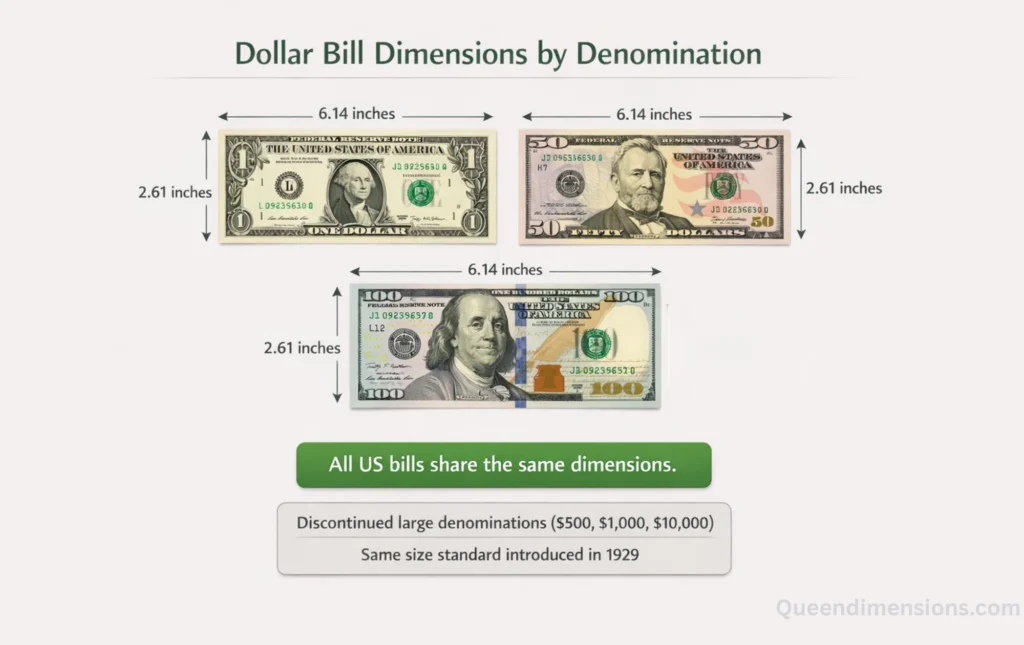
Yes. All US dollar bills share identical dimensions regardless of their monetary value. This uniformity makes America unique among world currencies.
The Federal Reserve chose this standardized approach for practical efficiency. ATMs process any denomination without adjustment, and vending machines accept all bills uniformly.
The $1 bill dimensions match exactly with higher denominations at 6.14 x 2.61 inches.
The $50 bill size maintains the standard 6.14 x 2.61 inch measurements. Ulysses S. Grant’s portrait distinguishes this mid-range denomination.
The $100 dollar bill dimensions remain identical despite being the highest value in common circulation.
Large denomination bills like $500, $1,000, and $10,000 notes were discontinued in 1969. All shared the standard 6.14 x 2.61 inch size introduced in 1929.
Historical Evolution of Dollar Bill Size
Before 1929 The “Horse Blanket” Era
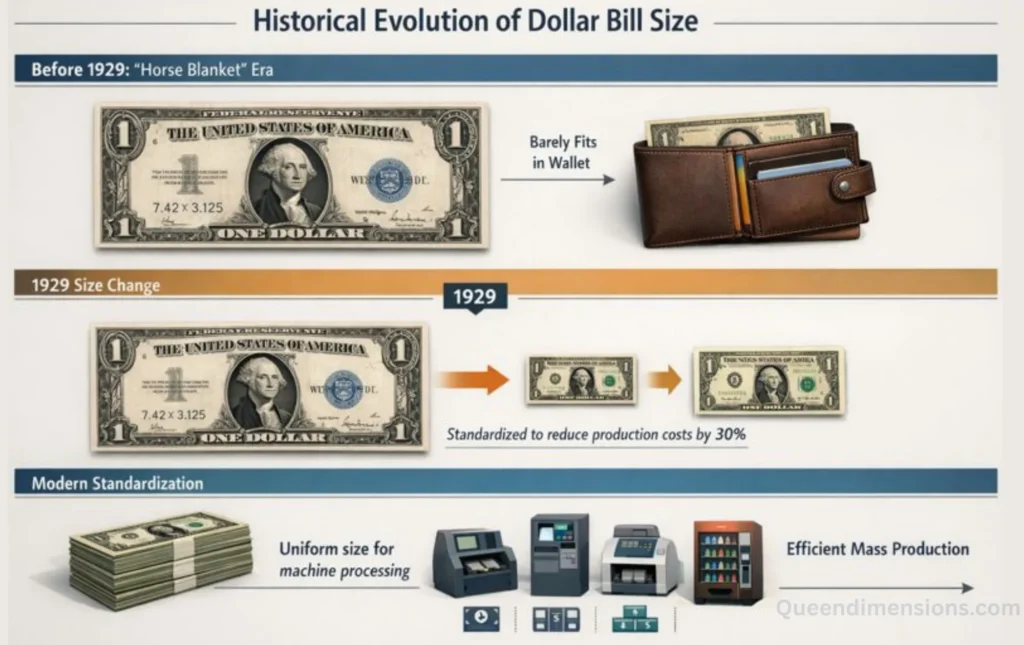
Early American currency came in various sizes, with some bills measuring up to 7.42 by 3.125 inches. People called these oversized notes “horse blanket currency” because they barely fit in wallets.
Why the Size Changed in 1929
The Treasury Department standardized all currency in 1929 to reduce production costs by 30 percent. Smaller bills lasted longer in circulation and required less storage space.
This modernization occurred during the Great Depression when cost efficiency became crucial. The change revolutionized American money overnight.
Modern Standardization Benefits
Uniform dollar bill measurements enable seamless machine processing across the banking industry. Currency counters, ATMs, and vending machines operate efficiently with standardized dimensions.
Mass production becomes cheaper when every denomination shares identical size specifications. Wallets and cash registers need no special compartments for different bill sizes.
Full XL Bed And Mattress Dimensions(Size, Height, Length & Width)
Dollar Bill Dimensions Compared to Everyday Objects

Credit Card vs Dollar Bill Size
A standard credit card measures 3.37 inches by 2.125 inches, making it significantly smaller than a dollar bill. The bill’s 6.14-inch length is nearly twice the credit card’s length.
Both items fit easily in standard wallets, though bills require folding. Credit cards maintain rigid structure while bills stay flexible.
Smartphone and Playing Card Comparisons
A dollar bill length roughly matches half a smartphone screen in portrait mode. Playing cards measure about 3.5 x 2.5 inches, making them shorter and slightly wider than bills.
The iPhone 13 Pro Max screen at 6.1 inches nearly matches the 6.14-inch dollar bill length. This comparison helps visualize the bill’s size without measuring tools.
Dollar Bill Thickness and Stacking Heights
How Thick Is a Single Dollar Bill?
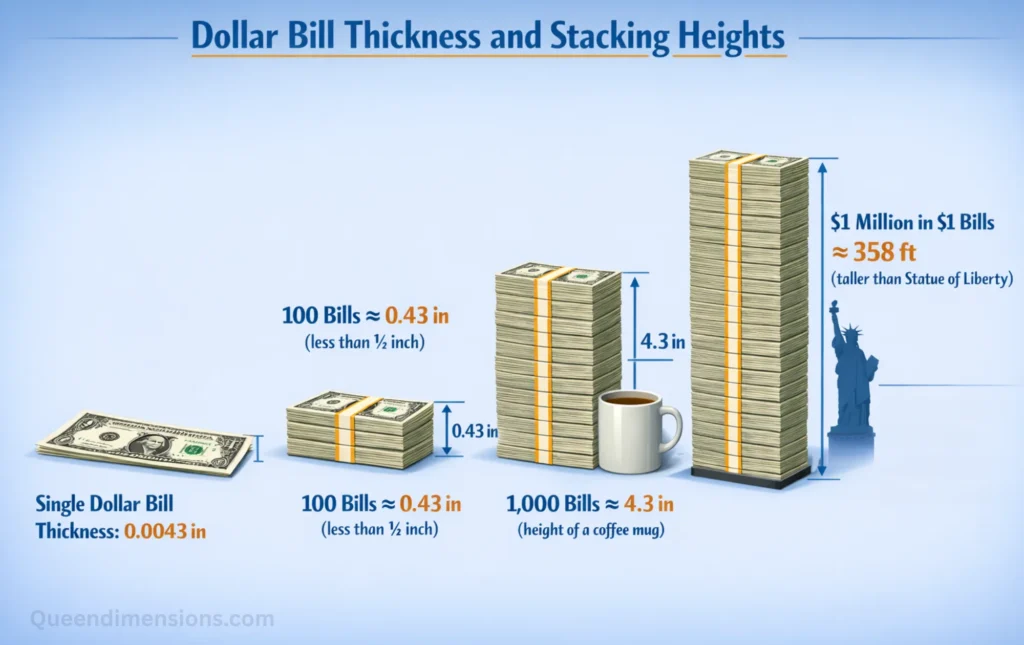
At 0.0043 inches thick, a single bill measures thinner than two sheets of regular printer paper. The cotton-linen composition creates durability despite minimal thickness.
This thinness allows for compact storage of large cash amounts. The material withstands daily use far better than wood pulp paper.
Stack Calculations: 100, 1,000, and 1 Million Dollars
One hundred dollar bills stack to approximately 0.43 inches high, less than half an inch. A thousand bills create a stack about 4.3 inches tall, roughly the height of a coffee mug.
One million dollars in $1 bills stacks to approximately 358 feet, taller than the Statue of Liberty at 305 feet. In $100 bills, a million dollars shrinks to just 3.58 feet, fitting easily in a large briefcase.
Why US Dollar Bill Dimensions Matter

ATM and Vending Machine Compatibility
Standardized bill dimensions allow ATMs to dispense any denomination without mechanical adjustments. Vending machines accept all bills through identical slot sizes.
This uniformity reduces manufacturing costs for cash-handling equipment. Financial institutions worldwide design machines around these consistent measurements.
Wallet and Storage Design
Standard dollar bill size dictates wallet compartment dimensions globally. Bill folds measure precisely to fit standard wallet sizes without excessive wear.
Cash registers and bank vaults optimize space based on these fixed dimensions. Storage efficiency improves when every bill occupies identical space.
Security Features and Anti-Counterfeiting
The 6.14 x 2.61 inch format provides optimal space for security elements like watermarks and security threads. UV inks and microprinting fit perfectly within standardized dimensions.
The Treasury updates anti-counterfeiting features without changing bill size. This consistency helps the public recognize genuine currency instantly.
RAM Bed Dimensions(Length, Width, Depth & Cargo Specs)
FAQ’s
What are the dimensions of a US dollar bill?
A US dollar bill measures 6.14 inches long by 2.61 inches wide, with a thickness of 0.0043 inches and weight of approximately one gram.
What’s the size of a $100 bill?
The $100 bill measures exactly 6.14 x 2.61 inches, identical to all other US currency denominations despite its higher value.
What is the size of a $20 bill?
The $20 bill dimensions are 6.14 inches by 2.61 inches, matching all United States currency since the 1929 standardization.
What does a $10,000 bill look like?
The $10,000 bill featured Salmon P. Chase and measured the standard 6.14 x 2.61 inches with green Treasury seal and serial numbers.
Conclusion
The 6.14 x 2.61 inch dollar bill dimensions represent nearly a century of American financial standardization. These measurements enable efficient banking systems and machine compatibility worldwide.
Uniform sizing across all denominations prioritizes practical efficiency over accessibility features found in other currencies. This consistency remains a defining characteristic of American paper money.

Hi, I’m Ethan Miller, the admin behind QueenDimensions.com. We make understanding Dimensions simple. Explore clear guides on realms, energy, and hidden layers of reality. No confusion, just clarity.