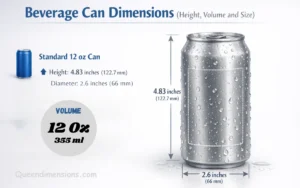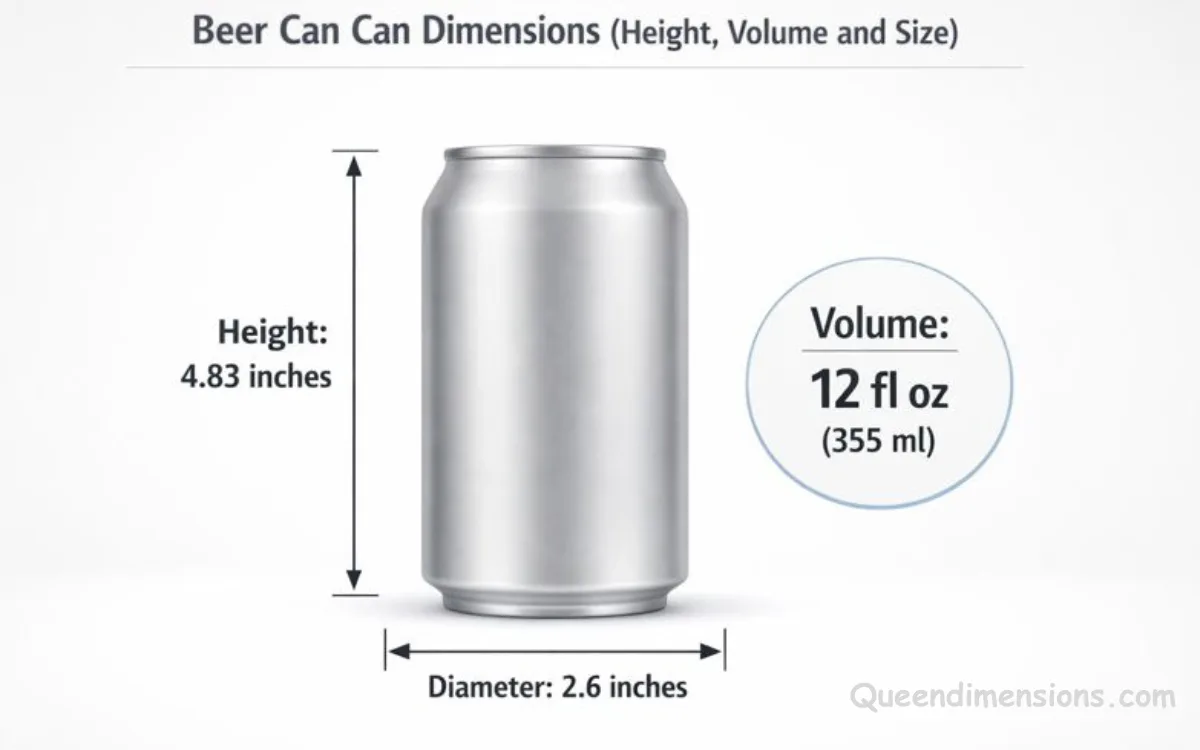
A standard 12 oz beer can stands roughly the same height as a dollar bill (4.83 inches) and has a diameter similar to a coffee cup opening (2.6 inches). Different can formats—from mini 8.4 oz cans to massive 32 oz crowlers—serve distinct purposes in the beverage market.
This guide breaks down every major beer can dimension, compares brands, explains measurement methods, and reveals why these specifications affect your drinking experience.
Standard Beer Can Dimensions Measurements & Conversions

The 12 oz standard beer can measures 4.83 inches tall and 2.6 inches in diameter, holding 355 milliliters of liquid. The end size (top opening) typically uses a 202 diameter specification, which refers to the standardized sealing mechanism used across most beverage canning lines.
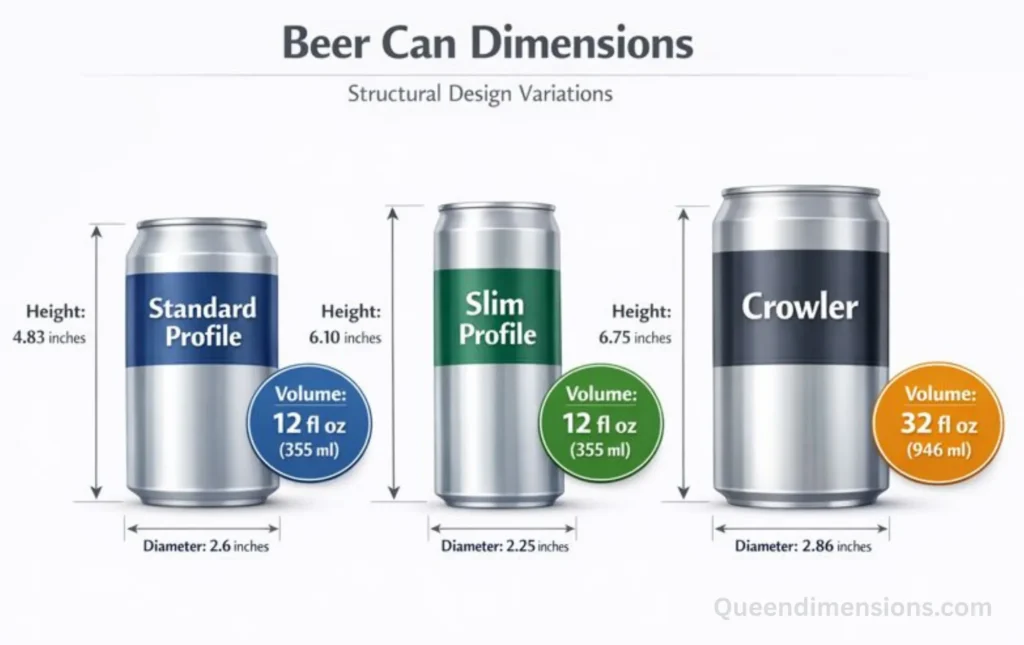
A 16 oz tall boy stands 6.19 inches high (157 mm) while maintaining the same 2.6-inch diameter (66 mm) as standard cans. The sleek can design measures 6.125 inches tall but only 2.25 inches wide (57 mm), creating a noticeably different profile despite holding the same 12 oz volume.
Beer Can Dimensions Variations With Real-World Comparisons
Structural classifications describe the shape profile, while volume-based sizes indicate how much beer the can holds.
A wider can cools faster due to increased surface area but requires more shelf space per unit. Taller cans stand out visually in retail displays but may topple more easily during transport.
Structural Design Variations
Standard Profile Cans
The traditional 2.6-inch diameter represents the industry baseline used by major breweries since the 1960s.
This width fits standard cup holders in vehicles (2.75-3 inches wide), vending machine slots, and automated packaging equipment. The height-to-diameter ratio of approximately 1.86:1 provides excellent stability during stacking and transportation.
Slim/Sleek Profile Cans
The 2.25-inch diameter sleek can creates a 2.7:1 height-to-diameter ratio, making it appear significantly more vertical and modern.
The reduced diameter means 15% less surface area for heat transfer, so these cans take slightly longer to chill but maintain temperature better once cold due to lower volume-to-surface ratios.
Wide Profile Cans
Crowler cans use a 2.86-inch diameter with a 300 end size instead of the standard 202. This wider format accommodates larger volumes while keeping height manageable for refrigerator storage. The 2.66:1 height-to-diameter ratio sits between standard and sleek designs, optimized for draft beer freshness rather than aesthetic appeal.
Volume-Based Size Variations

Small Format (7.5-8.4 oz)
At 4.75 inches tall, they’re perfect for portion control, tasting flights, or specialty high-ABV beverages where smaller servings make sense.
The 250 ml capacity equals roughly one-third of a standard beer, making it ideal for sampling multiple varieties without overconsuming. These cans weigh just 9.2 ounces when filled, compared to 13 ounces for standard cans.
Medium Format (12 oz)
This “Goldilocks size” dominates American beer sales because it delivers a satisfying single serving without requiring rapid consumption.
Storage efficiency peaks at this size—a standard refrigerator shelf (16 inches wide) fits exactly six cans side-by-side with minimal wasted space. The 31 square inches of printable label area provides ample branding real estate while keeping production costs reasonable.
Large Format (16-24 oz)
At 6.19 inches for 16 oz and up to 9 inches for 24 oz oil cans.
A 16 oz can weighs 17.3 ounces filled—notably heavier than standard cans, which affects shipping costs and carrying comfort.
Extra Large Format (32-64 oz)
The 32 oz format (946 ml) approximates a quart, traditionally the smallest unit for draft beer takeaway before canning technology advanced.
Some breweries offer 64 oz aluminum growlers, though glass remains more common at this volume due to reusability preferences.
These sizes serve sharing occasions rather than individual consumption. A 32 oz crowler provides four 8-ounce servings—perfect for couples or small gatherings.
The larger diameter (2.86 inches vs 2.6 inches) increases structural strength needed to support the additional weight and internal pressure.
Visual Comparisons
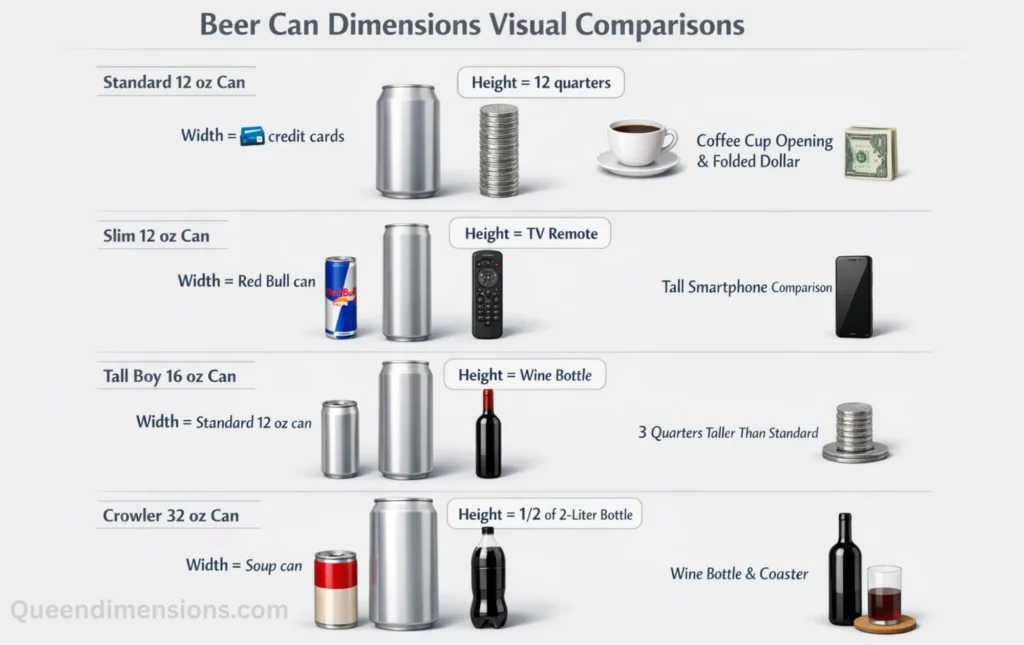
Standard 12 oz Can:
- Width = Three credit cards stacked flat (2.6 inches)
- Height = Stack of 12 quarters (4.83 inches)
- Weight = Two AA batteries when empty (15 grams)
- Fits in 98% of vehicle cup holders
- Same diameter as a standard coffee cup opening
- Height matches a folded US dollar bill (6.14 inches when unfolded)
Slim 12 oz Can:
- Height = Standard TV remote control (6.125 inches)
- Width = Red Bull energy drink diameter (2.25 inches)
- Profile = Wine bottle silhouette, narrower than standard
- Stores 15% more units per shelf foot than standard cans
- Comparable to a tall smartphone standing upright
- Fits tight spaces but takes 12% longer to chill due to reduced surface area
Tall Boy 16 oz Can:
- Height = Standard wine bottle height (6.19 inches)
- Width = Identical to 12 oz standard (2.6 inches)
- Weight = Three baseballs when filled (17.3 ounces)
- Extends 1.36 inches taller than standard—about three stacked quarters
- Similar height to a small water bottle
- Provides 29% more label space for artwork and information
Crowler 32 oz Can:
- Height = Half the height of a 2-liter soda bottle (7.6 inches)
- Width = Soup can diameter (2.86 inches)
- Volume = Four 8-ounce servings or half a growler
- Weighs 2.15 pounds filled—like a small laptop
- Stands as tall as a standard wine bottle plus coaster
- Requires specialized seaming equipment due to 300 end size
Storage Capacity & Weight
A typical refrigerator shelf (18 inches wide) holds approximately 32 standard cans when arranged optimally, but accommodates 37 slim cans in the same space.
The same shelf fits only 27 tall boys or 24 crowlers, reducing inventory density but commanding premium shelf positioning.
A 6-pack of standard cans weighs about 5 pounds (2.27 kg)—similar to a bag of flour—while a 12-pack reaches 10 pounds (4.54 kg).
Tall boy 6-packs weigh 6.5 pounds (2.95 kg), and a single crowler matches the weight of a 4-pack of standard cans.
Full XL Bed And Mattress Dimensions(Size, Height, Length & Width)
Beer Can Dimensions Comparison by Brand

Budweiser, Miller Lite, and Coors Light all follow the standard 12 oz dimensions (4.83″ × 2.6″), ensuring shelf compatibility and distribution efficiency, while craft breweries and hard seltzers use variations in height and diameter to signal premium positioning, style differentiation, or health-conscious branding.
How to Measure Beer Can Dimensions Correctly

Accurate measurements help designers, retailers, and homebrewers ensure proper fit, packaging, and storage. Household tools give ±0.1 in precision, while professional tools can reach ±0.01 in.
Tools Required
Height:
- Ruler or tape measure (metal, rigid, 12-inch / 300 mm)
- Flat, level surface
Diameter:
- Digital calipers (preferred, ±0.01 in)
- Ruler (acceptable for ±0.1 in)
Volume:
- Graduated cylinder or measuring cup (e.g., 500 ml for 16 oz cans)
Weight:
- Digital scale (0.1 g precision)
Optional/Advanced:
- Micrometer (for wall thickness, ±0.001 in)
- Carpenter’s level and good lighting for consistent measurements
Step-by-Step Measurement Guide
1. Measuring Height
- Place can on a flat, level surface
- Use ruler or calipers vertically, perpendicular to base
- Measure from bottom edge to top of the seam (exclude pull tab and end curl)
- For domed tops, measure up to seaming flange (~0.15–0.25 in below dome peak)
- Record in inches (nearest 1/16 in) and mm (nearest 1 mm)
- Take 3 readings and average
2. Measuring Diameter
- Measure at the widest part of the body (midpoint between base and neck)
- Avoid neck and base
- Use calipers gently; ruler works if careful
- Take 2–3 measurements at different heights and average
- Standard body diameter: ~2.6 in; neck diameter ~2.11 in
3. Measuring Volume / Fill Level
- Nominal fill volume: check printed label (12 oz / 355 ml typical)
- Total internal capacity: ~5–8% more to allow carbonation
- Pour contents into graduated cylinder or measuring cup slowly
- Allow foam to settle (~30 sec)
- Measured volume should be ±2% of labeled volume
4. Measuring Wall Thickness (Optional)
- Requires micrometer
- Cut small flat section from cylindrical body
- Body walls: 0.0035–0.004 in
- Can ends: 0.009–0.012 in
- Seams will measure thicker due to double metal overlap
5. Measuring End Size
- Important for equipment compatibility
- Measure curl (rim) diameter, not flat panel
- Standard 202 end: 2.125 in
- Crowler 300 end: 3.0 in
RAM Bed Dimensions(Length, Width, Depth & Cargo Specs)
FAQ’s
What is the standard size of a beer can?
In the USA, a standard beer can is 12 oz (355 ml), 4.83 ” tall, and 2.6 ” in diameter, representing the industry benchmark since the 1960s.
How tall is a 16 oz beer can?
A 16 oz “tall boy” stands 6.19 ” tall with a 2.6 ” diameter, about 1.36 ” taller than a standard 12 oz can.
What is the diameter of a beer can?
Standard beer cans are 2.6 ” in diameter; sleek cans narrow to 2.25 ” and crowlers widen to 2.86 ”, fitting typical cup holders.
How is beer can size measured?
Beer can size is measured by volume, height, and diameter, excluding pull tabs and end curls for storage and handling accuracy.
Are Budweiser and Coors cans the same size?
Yes, both use standard 12 oz cans at 4.83″ height × 2.6″ diameter, matching most major domestic lagers.
Why are some beer cans taller and skinnier?
Sleek cans (6.125″ × 2.25″) keep 12 oz volume while enhancing shelf visibility and brand recall for modern products.
What materials are beer cans made from?
Beer cans are made from 3004-H19 aluminum with food-grade epoxy interiors and UV-cured inks, fully recyclable.
How many 12 oz beer cans fit in a standard case?
A standard case holds 24 cans (4×6), six-packs hold 6, and 12-packs hold 12, all optimized for shelves and pallets.
What are the dimensions of a beer can in centimeters?
12 oz cans are 12.3 cm × 6.6 cm; 16 oz tall boys 15.7 cm × 6.6 cm; sleek 12 oz 15.6 cm × 5.7 cm; crowlers 19.3 cm × 7.3 cm.
Why are UK beer cans different sizes than US cans?
UK cans use metric volumes (330 ml, 440 ml, 500 ml) with the 440 ml (~14.9 oz) fitting between US 12 oz and 16 oz sizes.
Conclusion
Beer can dimensions directly impact consumer experience, storage efficiency, and brand positioning across the beverage industry.
Whether you’re comparing international can formats, measuring for DIY projects, or evaluating brand options, the dimensional specifications covered in this guide provide a comprehensive reference. From the 15-gram empty aluminum shell to the 202 end size standard, every measurement reflects decades of engineering refinement balancing material efficiency, consumer preference, and manufacturing practicality in the competitive beverage market.

Hi, I’m Ethan Miller, the admin behind QueenDimensions.com. We make understanding Dimensions simple. Explore clear guides on realms, energy, and hidden layers of reality. No confusion, just clarity.